
Author: Shruti Tripathi
Introduction
Every few months, a news headline reminds India of a problem it has repeatedly failed to solve. Sometimes, stray dogs attack a child on the way to school; at other times , an elderly woman suffers serious injuries while walking on a public road, or a road accident of motorcyclist due to unattended animals. These incidents are not merely isolated tragedies, they reflect a significant management challenge regarding the management of stray animals in public spaces.
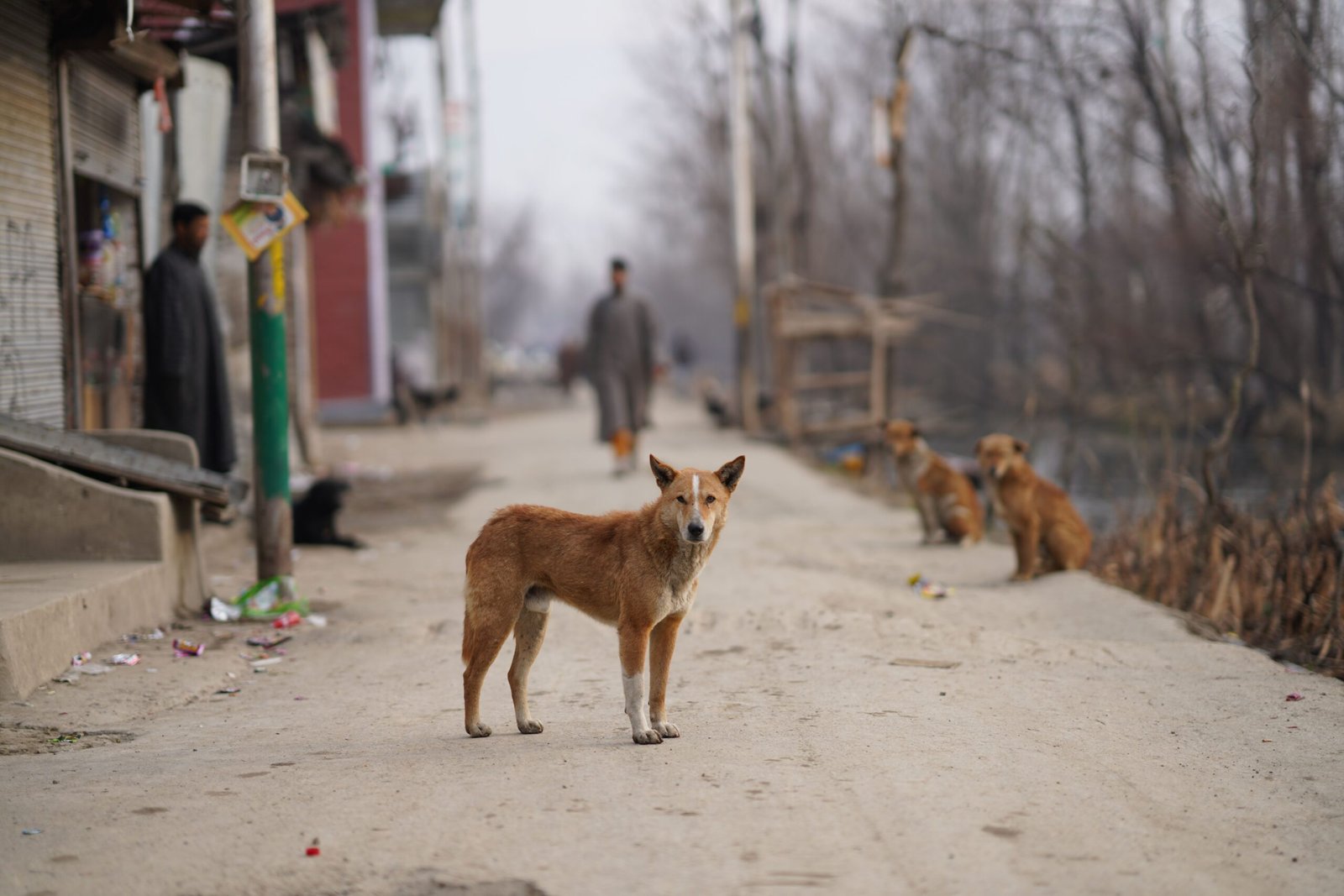
Among these concerns, the issue of stray dog has become the most urgent . India is home to an estimated 62-80 million stray dogs, and over 2.2 million dog- bite cases were reported in 2024 alone. Rabies- predominantly transmitted through dog bites – claims thousands of lives annually, with children being the most severely affected. protecting human life. Amidst growing public concern, the judiciary has also turned its attention to this issue as evidenced by the suo moto proceedings currently underway in the Supreme Court of India . The central question in this debate is how the law can ensure the humane Treatment of Animals while simultaneously
Understanding the scope of the problem
Public discourse often focuses on stray dogs but the problem is not limited to just one species. Stray cattle causes road accident and crop damages in several states particularly in northern India. In many cities and pilgrimage centres population have raised safety concern for both residents and tourist for example places like Mathura. Similarly, abandoned livestock and other animals also contribute to traffic hazards and public nuisance.
Therefore, this issue is not merely a matter of animal control stop it is a multidimensional challenge intertwined with public safety public health municipal governance and animal welfare a sustainable solution to this problem is possible only when the interest of both humans and animals is balanced.
Legal Framework Governing Stray Animals
There is no single specific legislation in India dedicated exclusively to regulating stray animals management. Instead, the subject is governed by a combination of central laws, municipal regulation and judicial directives.
The Animal Welfare Board of India (AWBI) was also constituted under this Act for the promotion of animal welfare. The government also introduced the Animal Birth Control (ABC) Rules, 2001 (which were amended in 2023), to address the problem of stray dogs. The ABC Rules aim to control the stray dog population through sterilisation and vaccination, rather than using harsh measures such as killing dogs indiscriminately.
This framework is further supported by the National Rabies Control Programme (NCRP), which is implemented by the Ministry of Health and Family Welfare which aims on preventing and controlling rabies through vaccination, disease monitoring, public awareness campaigns, and coordinated efforts by different government agencies. It shows that the management of stray animals is not only an issue of animal welfare but also an important matter of public health and safety.
Municipal authorities are entrusted with responsibilities related to public health, sanitation, and animal control State level laws such as cattle trespass act, address issues concerning stray cattle, while the Wildlife Protection Act 1972 may apply in cases involving monkeys and certain protected species.
Thus, while their legal framework is quite comprehensive implementation at the ground level often appears weak.
Constitutional Dimensions: Human Safety v. Animal Welfare
The constitutional debate to regarding stray animals seeks to strike a balance between 2 important values.
Article 21 guarantees citizens the right to life and personal liberty for stock interpreting this provision broadly the court held that it encompasses the right to live with dignity, as well as the right to safety and protection against avoidable dangers. Consequently, citizens can reasonably expect that public spaces will not become unsafe for them.
On the other hand, Article 51 A(g) imposes a fundamental duty on citizens to show compassion towards living creatures police stop this constitutional value reflects India’s long -standing commitment to animal welfare.
In the case of Animal Welfare Board of India v. A. Nagaraja (2014) , the Supreme court recognised animals as sentient beings , capable of experiencing pain and suffering, and emphasized the need for their humane treatment.
The primary challenge lies in balancing these two constitutional values. Human safety cannot be disregarded in the name of animal welfare, nor an unnecessary cruelty towards animals be justified in the name of public safety.
Recent judicial developments
Over the past years, the issue of a stray dogs and public safety has frequently came before the courts.
In July 2024 the Supreme Court initiated Suo Moto proceedings regarding stray dogs attacks and the implementation of animal control measures. Citing note of the increasing number of injuries and deaths caused by stray animal attacks, the Court asked The state government and local authorities to explain the steps they had taken regarding the issue.
On 7 November 2025, the Court ordered the authorities to remove stray animals from public roads and areas around schools, hospitals, and other institutions. The order has been challenged by several animal welfare organisations, expressing concern that it might result in the mistreatment of animals. However, the Court declined to withdraw its directions and emphasised the need to protect public safety.
In May 2026, the Supreme Court took an even firmer stance. It indicated that rabid dogs could be euthanised in accordance with the law. Furthermore, the court refuses to recall its earlier removal order and warned authorities that non-compliance could lead to contempt of court.
The court observed that it could not ignore the danger face daily by the children and vulnerable citizens. The bench comprising of Justice Vikramanath Kamaljit Sandeep Mehta and Justice NV Anjaria further indicated that its states may be directed to pay substantial compensation to victims of dog attack significantly, the court questioned whether compression should be reserved only for animals while ignoring the suffering of human victims.
The Andhra Pradesh High Court in City Hounded by Strays, kids pay… v. State of Andhra Pradesh (2026) stop Similarly emphasise that the state has a continuing constitutional obligation to protect citizens from threat posed by stray dog attacks.
Earlier in Savitri Yadav v. State of Haryana (2019) the Punjab and Haryana High Court had also highlighted that municipalities already possess sufficient power and duties to manage stray animals and compensate victims.
Municipal Responsibility and Governance Failure
A concern repeatedly highlighted by courts is that municipal authorities often fail to carry out their duties effectively. Local bodies are obliged to conduct periodic surveys of stray animals, to implement sterilisation and vaccination programmes, to set up animal shelters and to act swiftly on public complaints. However, in practice many municipalities find it difficult to perform these functions due to limited funds, shortage of trained veterinary staff, inadequate facilities and weak monitoring mechanisms. As a result, these methods of controlling the stray animal population often fail to achieve the desired effect.
Although laws and policies provide a clear framework for addressing the issue, implementation is often uneven. Many programmes suffer from delays, insufficient execution, or a lack of sustained follow-up, which allows the problem to continue. Questions have also been raised about the efficient use of resources allocated for animal welfare initiatives, including vaccination and sterilisation campaigns. Administrative inefficiencies, weak oversight, and a lack of transparency can further undermine the effectiveness of these measures. As a result, the stray animal issue reflects not only concerns about animal welfare but also broader shortcomings in governance and public administration. When authorities are unable to implement policies effectively, both communities and animals bear the consequences.
The Sterilization Debate and Feeder Accountability
India’s approach to managing stray dogs largely depends on the Animal Birth Control Programme. The programme seeks to control the growth of the dog population through sterilisation and vaccination while avoiding unnecessary harm to animals.
In the case of Bharat Amratlal Kothari v, Dosukhan Sindhi (2010), the Supreme Court upheld the legality of this humane approach. However, many critics argue that due to poor implementation, the program has failed to deliver the expected result in several cities.
On the other hand, certain studies and assessment indicate that positive outcomes can be achieved if the programme is implemented effectively. An assessment of the Animal Birth Control Programme in Bengaluru suggested a decline in the street dog population and an improvement in sterilisation rate between 2019 and 2023. This makes it clear that the issue lies more with the implementation than with the policy itself.
Another controversial issue relates to the feeding of stray dogs. While many people feed these animals out of compassion dispute of an arises between feeders and local residents. The recent observation by the Supreme Court have raised questions regarding the accountability of habitual feeders, A balanced approach would involve feeder registration cooperation with sterilisation and vaccination drives and clearly defined responsibilities rather than blanket restrictions or blanket immunity.
Challenges and the way forward
The current situation shows that making laws alone is not enough. These laws must also be properly followed and enforced. For a long-term solution, it is important to adopt a “One Health” approach, which means understanding that the health of people, animals, and the environment are connected. Problems like rabies, poor waste management, lack of cleanliness, and the increasing number of stray animals should be addressed together rather than separately.
Some important reforms that may be considered are:
- Rigid implementation of the Animal Birth Control Rules 2023.
- Expansion of sterilisation and vaccination programmes.
- Stricter penalties for those who abandon domestic animals.
- Improved data collection system and public awareness campaigns.
- A dedicated compensation mechanism for victims of dog attacks and other animal related incidents.
International examples from countries like the Netherlands and the United kingdom demonstrate that stray animal population can be significantly reduced through responsible ownership, registration system, adoption programs and large-scale sterilization initiatives without resorting to indiscriminate culling.
Conclusion
Stray animal management is not just an animal welfare issue it is also connected with public safety public health and the responsibility of local authorities. India already has laws and policies such as animal birth control framework and the national rabies control programme to deal with these proper problems the main issue is not the absence of loss but the failure of to implement them properly police stop the goal should not be to choose between human and animals. Instead, efforts should be made to protect people from harms while also ensuring that animals are treated humanely.
A good society is one that cares for both human beings and animals. If authorities properly enforce existing laws and fulfil their responsibilities it is possible to ensure public safety and animal welfare at the same time.